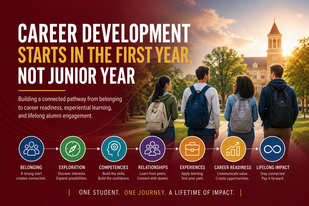
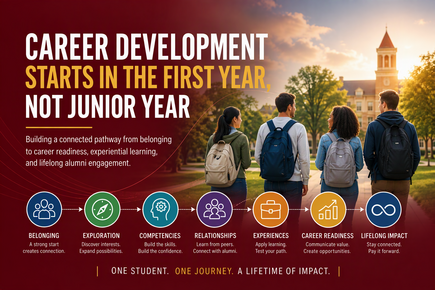
Walk into almost any career center and ask when students typically begin engaging in career development.
The answer is usually the same.
Sophomore year.
Junior year.
When internship recruiting starts.
When students finally realize graduation is getting close.
By then, we have already missed the greatest opportunity.
I have spent years working with students, alumni, employers, and university leaders, and I have become convinced that one of the biggest challenges facing higher education is that career development is often introduced too late. We have unintentionally created a system that treats career readiness as a transaction rather than a developmental process.
Students are frequently told to "focus on academics now and worry about careers later."
The reality is that employers are not hiring a GPA. They are hiring a person.
That person must develop confidence, communication skills, professional identity, relationships, networks, adaptability, resilience, and increasingly, digital and AI fluency. None of those competencies emerge overnight during junior year.
They develop over time.
The Institutional Challenge
Most colleges and universities were built around a developmental model for academic success but not necessarily for career success.
Students arrive on campus and immediately receive support for:
- Academic advising
- Student engagement
- Wellness
- Residence life
- Financial aid
- Identity development
Career development, however, is often positioned as something to be addressed later.
The consequence is predictable.
Many students spend their first two years disconnected from career planning. They may choose majors without understanding career pathways. They delay networking. They miss early mentoring opportunities. They fail to build professional experiences that compound over time.
Then, during junior year, panic sets in.
Students rush to build resumes, search for internships, learn LinkedIn, develop interview skills, and figure out what they want to do after graduation, often all at the same time.
This model creates anxiety for students and limits outcomes for institutions.
Career readiness should not be viewed as a destination reached near graduation.
It should be viewed as a developmental journey that begins the moment a student arrives on campus.
A Student Development Strategy, Not a Placement Strategy
Career development is fundamentally human development.
Before students can confidently pursue opportunities, they must first answer deeper questions:
- Who am I?
- What do I value?
- What am I curious about?
- What strengths do I possess?
- How do I communicate my story?
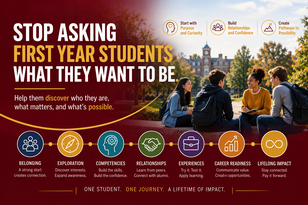
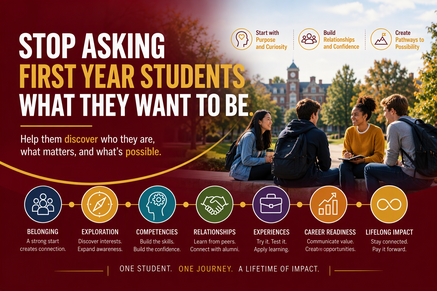
The first year should focus on exploration, self-awareness, and confidence building.
Students do not need to know exactly what career they want.
They need structured opportunities to discover possibilities.
This means introducing career conversations early through:
- Career assessments
- Purpose exploration
- Mentoring relationships
- Alumni engagement
- Informational interviews
- Reflection activities
- Micro-experiential learning opportunities
The goal is not immediate career certainty.
The goal is career curiosity.
Once that curiosity is established, engagement grows naturally.
Technology as an Enabler, Not the Solution
Universities often invest heavily in technology platforms and then wonder why student engagement remains low.
Technology alone does not create outcomes.
Technology amplifies intentional strategy.
The most effective career ecosystems use technology to create continuity across the student journey.
Platforms can:
- Connect students with mentors
- Track engagement
- Facilitate job shadowing
- Deliver AI literacy programs
- Document experiential learning
- Create co-curricular transcripts
- Monitor student progress toward milestones
When used effectively, technology allows institutions to move from episodic interactions to continuous development.
Students should be able to see their growth over time.
Universities should be able to identify who is thriving and who may need support before they fall behind.
The future of career development is not simply better software.
It is the integration of technology with student development theory and human connection.
Engagement Begins With Community
Students engage when they feel connected.
This is why mentoring is so powerful.
A first-year student who develops an early relationship with an upper-class mentor, alumni volunteer, or employer partner immediately gains something invaluable:
Perspective.
Mentoring transforms career development from an abstract concept into a personal conversation.
Students stop asking:
"What should I do?"
And start asking:
"How can I learn more about this path?"
Early engagement also increases the likelihood that students will participate in:
- Career coaching
- Employer events
- Career fairs
- Networking programs
- Experiential learning
- Internships
- Leadership opportunities
Every interaction builds confidence.
Every relationship expands possibility.
Every experience develops competency.
Career development works best when it becomes part of a student's community rather than another office they visit in a moment of crisis.
Measuring What Matters
For decades, institutions have focused primarily on first-destination outcomes.
Job placement rates matter.
Graduate school placement matters.
Employer satisfaction matters.
But those metrics tell us what happened at the end of the journey.
They tell us little about how students got there.
Forward-thinking institutions should also measure developmental indicators throughout the student lifecycle:
First-Year Metrics
- Career assessment completion
- Mentor participation
- Career coaching engagement
- AI literacy completion
- Informational interviews conducted
Second-Year Metrics
- Job shadowing participation
- Career pathway exploration
- Skill credential attainment
- Portfolio development
Third-Year Metrics
- Internship attainment
- Experiential learning participation
- Leadership engagement
- Professional networking growth
Fourth-Year Metrics
- Employment outcomes
- Graduate school acceptance
- Offer quality
- Alumni engagement continuation
When institutions track developmental milestones instead of focusing exclusively on placement data, they gain visibility into the factors that actually produce successful outcomes.
The Future of Career Readiness
The future belongs to institutions that view career readiness as a university-wide responsibility rather than a single department's responsibility.
Career development should be embedded across the student experience.
It should begin during orientation.
It should be reinforced through advising, faculty partnerships, mentoring, experiential learning, and employer engagement.
It should be supported by technology.
It should be measured consistently.
Most importantly, it should start on day one.
If we wait until junior year, we are asking students to sprint.
If we begin in the first year, we give them time to grow.
And growth, not urgency, is what ultimately produces confident graduates, meaningful careers, and measurable student success.
Closing Thought
The strongest career outcomes are not created by a last-minute job search. They are created by four years of intentional development. Career readiness is not an event. It is an ecosystem. And the institutions that recognize this truth will be the ones that best prepare students for the future of work.